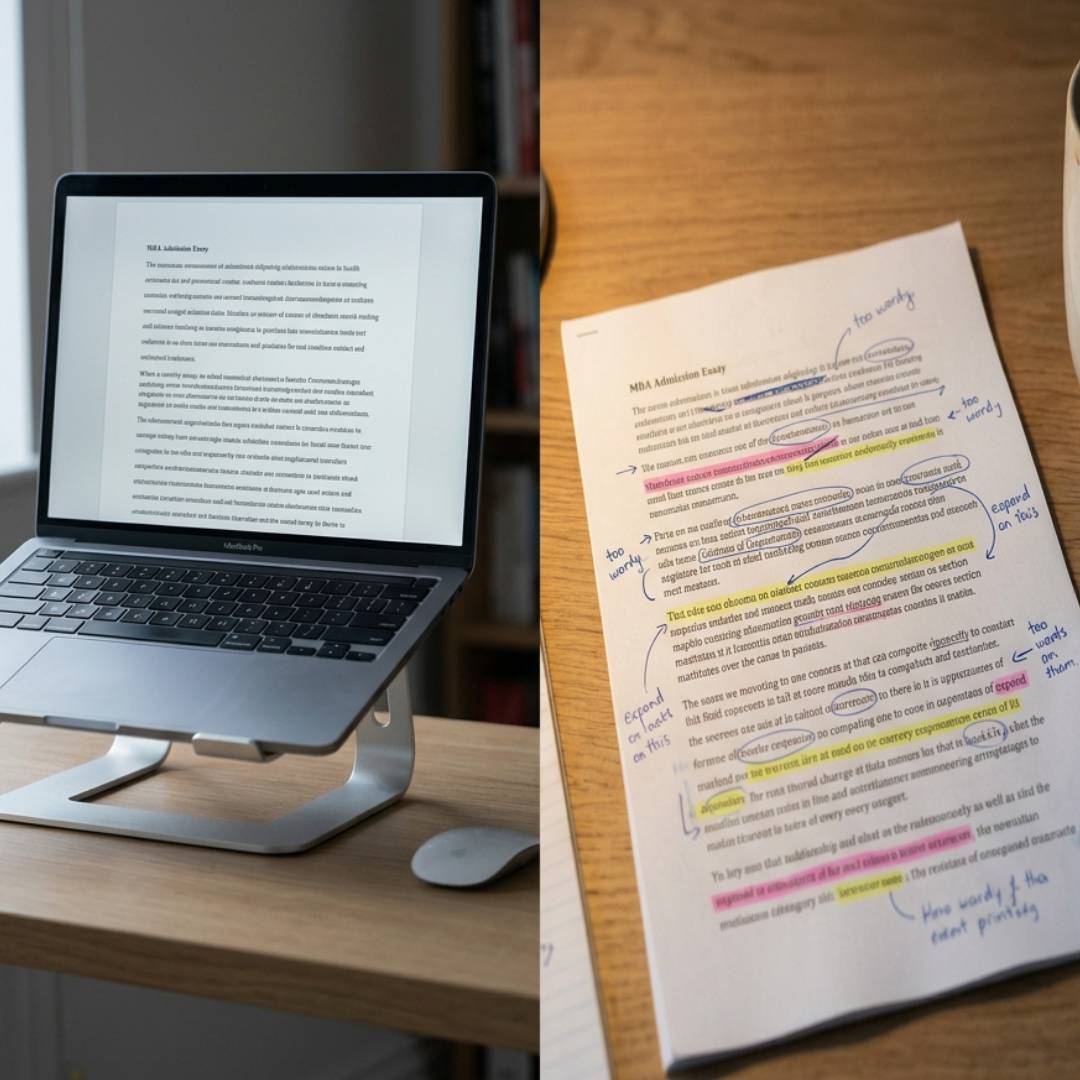
For a long time, a 665+ GMAT felt like a safety net. It signaled raw ability and the kind of intellectual horsepower that could compensate for a predictable resume or a cautious essay.
In the 2026 admissions cycle, that safety net is not as reliable as it used to be.
"Perfect" is no longer impressive. It is expected, and increasingly, it is questioned. With AI tools now a standard part of the applicant's toolkit, polished writing is the new baseline. As a result, admissions committees at M7 schools and LBS are seeing a surge of essays that are technically flawless but emotionally empty.
They read well. They say the right things. And they are easy to forget.
The Real Divide: Polished vs. Proven
What’s emerging isn’t a gap in talent, but a gap in authenticity.
On one side are applicants who use AI to generate their narrative. The result is often a coherent, professional essay where the stories feel assembled rather than lived.
On the other side are applicants who use technology to sharpen their thinking but keep the core of the story grounded in real experience. Admissions readers can usually spot the difference within the first paragraph. Once an essay feels slightly off or overly engineered, it does more than weaken the application. It starts to raise doubts about how the candidate actually thinks and makes decisions.
1. Specificity is What Cuts Through
AI is very good at sounding right. It is much worse at being concrete.
That’s your advantage.
Consider the difference:
The Generic Version:
"I am a collaborative leader who thrives in fast-paced environments and values driving impact through teamwork."
(This could apply to thousands of applicants.)
The Specific Version:
"Three weeks into the merger, I realized our lead developer hadn’t slept in 48 hours. I didn’t give a pep talk. I took his laptop, ordered two pizzas, and told him to go to the hotel. I spent the next four hours reconciling the API documentation myself."
It’s not about sounding impressive. It’s about being specific enough that the reader can actually picture the moment.
The Rule:
If a sentence in your essay could belong to someone else with a similar background, it is not doing its job. Detail is one of the few things AI still struggles to fake convincingly.
2. Let Some Imperfection Show
Most AI-generated writing is designed to be balanced, polished, and risk-averse. Strong essays are not.
What makes a story memorable is often a moment of uncertainty, a bad decision, or a perspective that is still evolving. Schools are not just evaluating outcomes. They are trying to understand how you think when the answer is not obvious.
Do not be afraid to show where your instincts were wrong before they improved. That is often where judgment becomes visible.
3. The "Authenticity Check" is Real
If you are wondering why schools like Berkeley Haas, Yale, and LBS are leaning more heavily on video essays and spontaneous prompts, there is a reason.
They are looking for consistency. Does the person in the video sound like the person in the essay?
If your written voice feels overly polished or distant, and your video feels more natural, the gap becomes noticeable. You do not need to be perfect in both. You just need to sound like the same person.
How to Pressure-Test Your Story
Before you hit submit, step back and ask three uncomfortable questions:
The Friend Test:
If I read this to a friend, would they say “this sounds like you” or “this sounds like an impressive stranger”?
The Risk Test:
Is there at least one moment here that feels slightly vulnerable or unpolished to share?
The Replacement Test:
Could someone else with my exact background submit something very similar?
If the answer to that last question is yes, it is worth going deeper.
Final Thoughts
A high GMAT score still opens the door. It proves you can handle the work.
What happens next depends on whether your story feels real.
That’s the part most applicants struggle with.
Not because they lack experiences, but because they don’t know how to translate those experiences into a narrative that actually reflects how they think. They either default to what sounds “right,” or they over-polish until the story loses its edge.
This is where the process matters.
Because in a pool full of polished applications, the ones that stand out are not the most refined. They are the most real.
Preparing for MBA interviews?
Strong test scores will get you an interview. Your answers are what convert it into an offer.
Planning to Apply to a Top MBA or Graduate Program?
Book a free 15-minute strategy session to evaluate your GMAT/GRE preparation, profile competitiveness, and admissions goals.
We’ll discuss your current situation, target programs, and the most effective preparation strategy for your application timeline.


Ready to kickstart your exam preparation?
El Brujo Method has a proven track record helping students get accepted to leading universities, business schools and specialized programs.
 Made with Scene.io