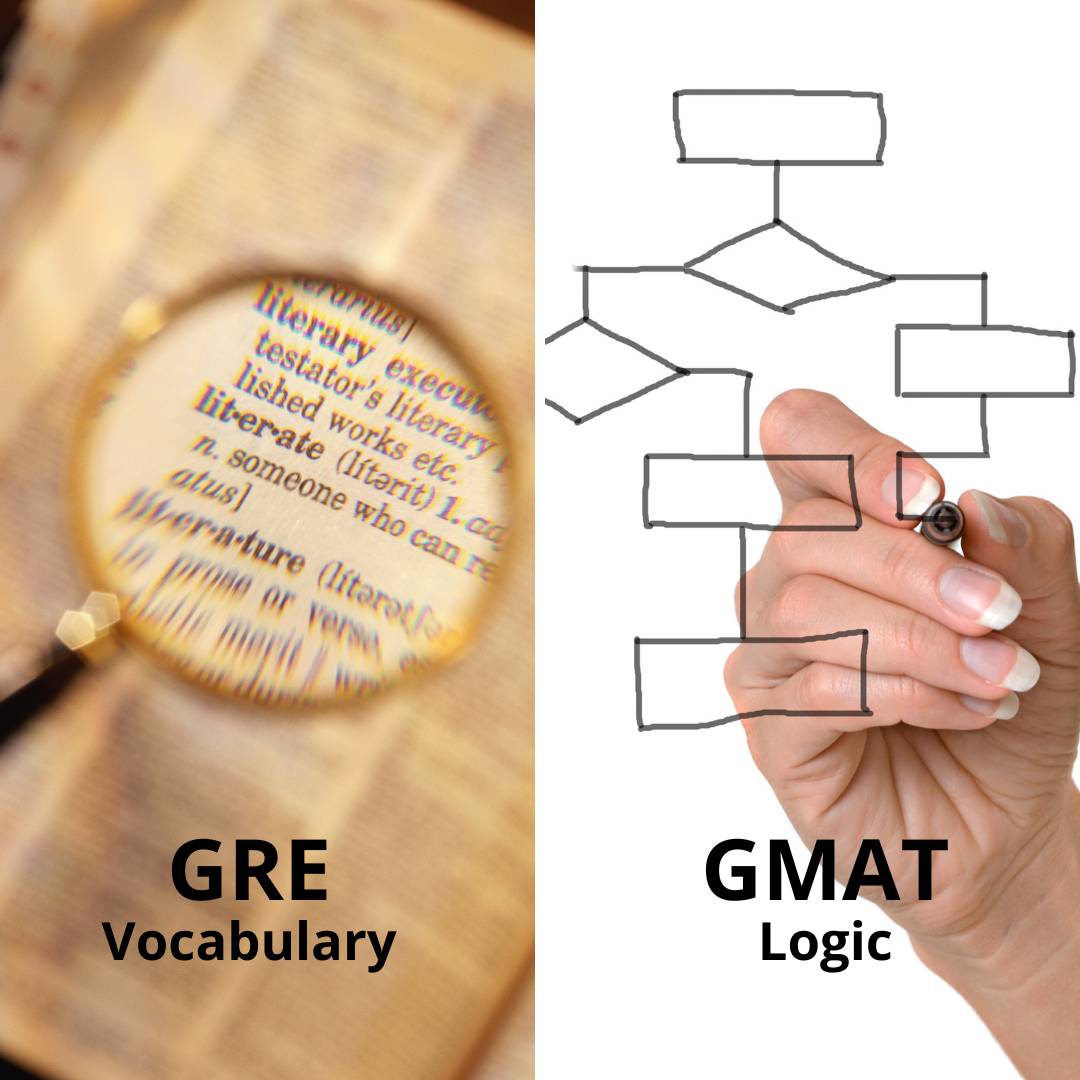
If you are deciding between the GRE and the GMAT, your choice often comes down to one question: Would you rather memorize thousands of words or master the mechanics of an argument?
While both exams test your English proficiency, their Verbal sections have completely different "personalities." The GRE is a test of linguistic precision, while the GMAT Focus Edition—having recently removed all formal grammar questions—is now a test of logical deconstruction.
The GRE: A Test of Vocabulary
The GRE remains the "lexical" exam. About half of the Verbal section consists of Text Completion and Sentence Equivalence questions. These are essentially high-level "fill-in-the-blank" puzzles that require you to understand the subtle nuances of sophisticated academic English.
- The Challenge: You will encounter "GRE words"—obscure, high-utility academic terms like laconic, obsequious, or fastidious. To be competitive, most students must memorize over 1,000 new words.
- The Skillset: This test rewards students with strong memories and a background in the humanities. If you enjoy reading The Economist or The New Yorker and can pick up on subtle tonal shifts in writing, the GRE will feel like home.
The GMAT: A Test of Logic
In 2024, the GMAT Focus Edition made a major change: it removed Sentence Correction entirely. This means you no longer have to memorize rules about dangling modifiers, parallelism, or subject-verb agreement.
Instead, the GMAT Verbal section is now purely focused on Critical Reasoning and Reading Comprehension.
- The Challenge: Since grammar is gone, the difficulty has shifted to "verbal logic." You are asked to find the flaw in an argument, identify an underlying assumption, or strengthen a conclusion. The passages are often dense and business-oriented.
- The Skillset: This test rewards "engineers of language." If you are good at spotting "circular reasoning" or can break down a complex claim into its logical components, the GMAT is your best bet. You don't need to know what recalcitrant means, but you do need to know exactly why a CEO's argument for a merger is logically unsound.
The Verdict: Which Should You Take?
Choosing the right test can save you months of frustration. Consider these two profiles:
Choose the GRE if:
- You have a strong "verbal memory" and don't mind flashcards.
- You are a native or highly fluent speaker who has a wide vocabulary.
- You prefer a test that lets you skip and return to questions (the GRE's unique navigation).
Choose the GMAT if:
- You hate memorizing vocabulary lists.
- You have a logical, analytical mind and prefer "solving" a verbal question rather than "knowing" the word.
- You are a non-native speaker who finds high-level GRE vocabulary more intimidating than logical structures.
Final Takeaway
The GRE tests what you know (vocabulary), while the GMAT tests how you think (logic). Because the GMAT has moved away from formal grammar, it has become much more approachable for students who struggle with technical "rules" but excel at strategic thinking.
Planning to Apply to a Top MBA or Graduate Program?
Book a free 15-minute strategy session to evaluate your GMAT/GRE preparation, profile competitiveness, and admissions goals.
We’ll discuss your current situation, target programs, and the most effective preparation strategy for your application timeline.


Ready to kickstart your exam preparation?
El Brujo Method has a proven track record helping students get accepted to leading universities, business schools and specialized programs.
Most business schools now treat the GRE and GMAT equally, so there’s no wrong choice in terms of eligibility. However, the GMAT still tends to carry a reputation for stronger quantitative rigor—particularly in finance, consulting, or data-driven programs.
That said, admissions committees are more interested in how well your test score reflects your potential for success. The best test for you is the one that showcases your skills most effectively.
 Made with Scene.io