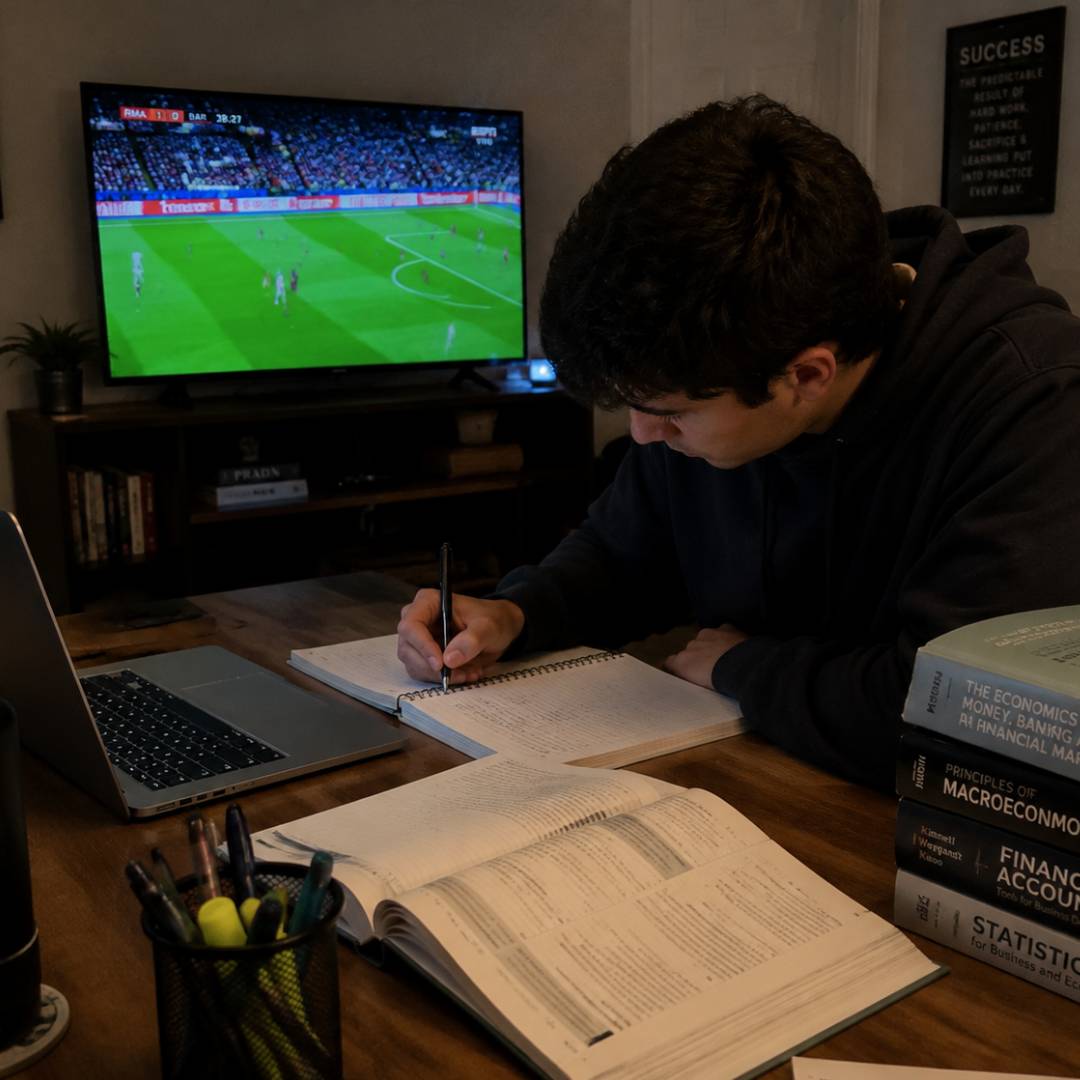
Let’s be realistic. If you are a football fan trying to balance a 60-hour work week with elite exam preparation, the ongoing 2026 World Cup is a structural threat to your study timeline. The standard, rigid advice from traditional test-prep companies is always the same: "Just lock yourself in a room, cut out distractions, and completely sacrifice your hobbies until you hit your target score."
That advice fails because it completely ignores human nature. If you try to force yourself to execute a grueling mock exam while your favorite national team is playing a crucial group-stage match, you will end up doing both poorly. You will spend half your mental energy staring at a complex Data Insights or Quantitative Comparison prompt, while the other half is entirely consumed by a live score update on your phone.
You do not need to boycott the tournament. Instead, you need a tactical substitution strategy that treats your study schedule like a high-performance tournament campaign. Because both the GMAT Focus and the shorter GRE are compact, sub-2-hour sprints, they are uniquely well-suited for a compressed, tactical schedule if you adjust your training parameters.
1. Shift from "Macro" to "Micro" Study Blocks
During a normal study month, your schedule likely relies on long, deep-focus blocks of 2 to 3 hours over the weekend. During the World Cup, that entire architecture will collapse under the weight of match schedules and social commitments.
Instead of fighting the calendar, switch your preparation to high-intensity Micro-Blocks. The structural design of the shortened 2026 exams plays perfectly into this:
- The Halftime Drill (15 Minutes): The break between halves is exactly enough time to execute a mini-set. For GMAT Focus takers, this is 5 targeted Quantitative Reasoning questions or 3 Critical Reasoning prompts. For GRE takers, it’s a focused 6-question set of Text Completion and Sentence Equivalence. Score them immediately, and note down the errors.
- The Pre-Match Sprint (30–45 Minutes): This matches the exact duration of a single GMAT section (45 minutes) or a pair of GRE sections (18–26 minutes each). Do one full section block right before the first match of the day kicks off. Once the referee blows the whistle, your baseline study obligation for that window is officially cleared.
2. Match-Day Triage: High-Cognitive vs. Low-Cognitive Prep
Not all exam preparation requires the exact same level of mental bandwidth. Trying to learn a completely new, complex mathematical property or parsing a dense, abstract Reading Comprehension passage while a loud match is playing in the background is a complete waste of time.
Divide your study tasks cleanly based on the tournament calendar:
- On Non-Match Days (Your Recovery Windows): Dedicate these precious quiet slots to high-cognitive load tasks. This is when you deep-dive into conceptual weaknesses, review comprehensive strategy guides, analyze your adaptive scoring thresholds, or take a full-length official practice exam.
- On Match Days: Limit your preparation entirely to low-cognitive maintenance. For GRE students, this means passive vocabulary flashcard review during pre-game shows or light geometry formula drills. For GMAT takers, focus on fast graphical-interpretation scanning in Data Insights. You are keeping the engine warm without trying to rebuild the transmission.
3. The "Tactical Substitution" Rule
If you are going to watch a mid-week match during what used to be your prime evening study window, you must make a formal tactical substitution somewhere else in your week.
If you take 2 hours off on a Tuesday afternoon to watch a game, you must contractually replace those 2 hours by waking up 45 minutes earlier on Wednesday, Thursday, and Friday. If you do not explicitly schedule the replacement window before you sit down to watch the match, you are simply accumulating study debt that will eventually derail your upcoming Round 1 or Round 2 deadlines.
The Ultimate Group-Stage Rule
At the end of the day, your success on the GMAT Focus or the GRE doesn’t come down to perfect conditions; it comes down to consistency under sub-optimal conditions.
Think of this tournament month as your application’s "group stage." You don't need a flawless, blowout performance every single day. You just need to secure the necessary points to advance to the next round. By executing sharp, disciplined micro-blocks, managing your cognitive load on match days, and aggressively replacing your missed study hours, you ensure that your business school timeline stays alive well into the knockout rounds.
Enjoy the tournament, trust your execution strategy, and don't let a month of football cost you a year of your career.
Planning to Apply to a Top MBA or Graduate Program?
Book a free 15-minute strategy session to evaluate your GMAT/GRE preparation, profile competitiveness, and admissions goals.
We’ll discuss your current situation, target programs, and the most effective preparation strategy for your application timeline.


Ready to kickstart your exam preparation?
El Brujo Method has a proven track record helping students get accepted to leading universities, business schools and specialized programs.
 Made with Scene.io